

You’re Exhausted Because You’re Carrying Too Much Alone


For many reasons, I assert that homeschooling is a special vocation. One of the biggest reasons I say this is that there is a very particular kind of exhaustion that settles over a homeschooling parent when the day is technically done, but the work of the homeschool is somehow still very much alive. It can be (though ‘should it be?’ is a valid question) an all-encompassing pursuit.
In my homeschool, the math books might be closed. The pencils may have made their way back into the basket, or at least most of them. Someone has likely abandoned a stack of magnatiles in the middle of the hallway (I’ll remind them to pick them up…or maybe slip on them later), and there are library books waiting by the door to be returned…probably overdue. Dinner is somewhere between “I have a plan” and “maybe toast counts,” and the 2-year old has removed one sock again for reasons that will remain mysterious to everyone.
And still, my hands and my mind are moving.
I’m probably thinking about the child cried over math this morning. Another who suddenly seems ready for harder books. The science kit I forgot to hit ‘complete purchase’ on. The co-op email thread I haven’t yet answered. The read-aloud you meant to preview before handing it to your oldest who is already on chapter six. The toddler who needs more outside time. The grocery order. The laundry. The budget (off track, inevitably). The question humming under all of it:
Can I actually keep doing this?
If you have found yourself wondering whether homeschooling is right for your family because you are so deeply tired, I want to gently offer another possibility.
Maybe homeschooling is not the problem.
Maybe carrying it alone is.
Homeschooling was never meant to be a solo performance. It may happen largely during the hours when one parent is home with the children. It may have one primary teacher. It may have one person who knows where the phonics cards are, which child needs a snack before math, why the nature journal paper cannot be the shiny kind, and exactly how many library holds are currently waiting for pick up.
But home education is still a family responsibility.
And when one parent becomes the keeper of every decision, every plan, every adjustment, every worry, every schedule shift, and every quiet fear, the weight can become crushing.
Not because that parent is weak.
Because the load is real.
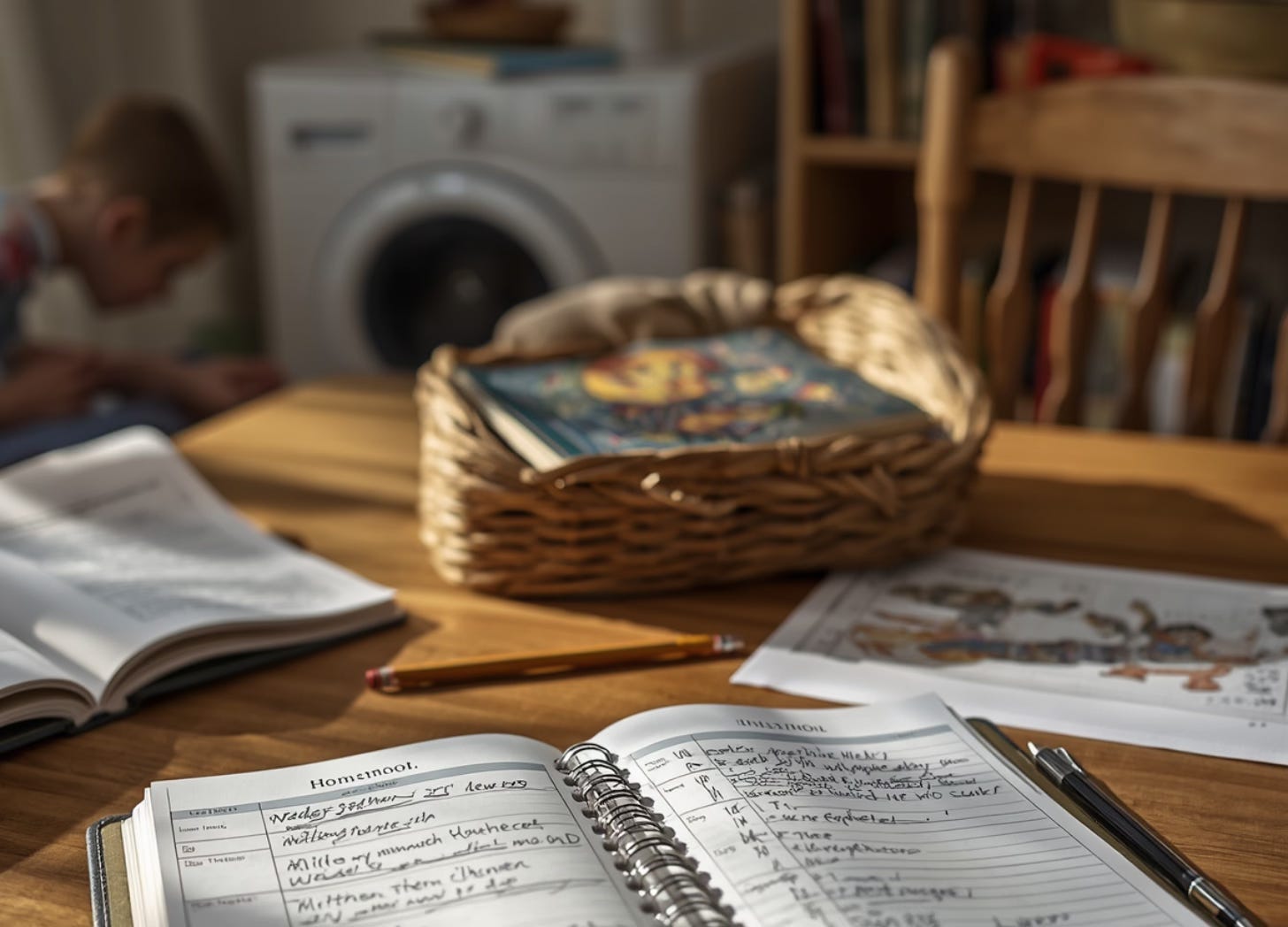
The mental load of homeschooling is real work
We use the phrase “mental load” so often now, but I think many homeschool parents still struggle to apply it to home education.
The mental load is the invisible work of noticing, remembering, planning, anticipating, deciding, tracking, adjusting, and holding the whole picture in your mind. It is the work of carrying the homeschool in your head before, during, and after the hours when anyone else would say school is “happening.”
It is not just doing the task.
It is knowing the task exists.
It is not just teaching the lesson.
It is knowing which lesson comes next, whether the child is ready for it, whether the curriculum is still serving your family, whether you need to slow down, whether you need to change your expectations, whether the baby will nap long enough to get through it, and whether you should have started earlier in the year.
The mental load of homeschooling can include:
Choosing curriculum.
Planning lessons.
Tracking each child’s progress.
Noticing when something is not working.
Researching solutions.
Finding books.
Managing library holds.
Remembering co-op dates and field trips.
Adjusting for sick days, hard days, growth spurts, and real life.
Wondering if you are doing enough.
…and so much more.
And because homeschooling happens inside the home, this load often tangles itself with everything else a homemaker or stay-at-home parent would tackle in a day.
Meals. Laundry. Dishes. Sibling conflict. Rest time. Screens. Budgets. Outside time. Bedtime. Character formation. The emotional climate of the house.
It can become nearly impossible to tell where homeschooling ends and regular family life begins. And in fact, homeschooling can amplify or make some of these other home maintenance duties feel even heavier.
While this is truly part of the beauty of homeschooling, it can also become something that feels like a burden.
Supportive is not always the same as involved
Many homeschooling parents have supportive partners.
Their partner agrees with homeschooling. They appreciate it. They may say, “You’re doing a great job.” They may trust the main teaching parent completely, and there is something genuinely meaningful about that kind of trust.
But sometimes, support stays too vague to actually lighten the load.
A partner can believe in homeschooling and still leave one parent carrying nearly all of it alone.
This is where many homeschool parents feel stuck. They do not necessarily feel opposed. They do not feel abandoned in some obvious or dramatic way. They may even feel grateful that their partner is affirming and not questioning every curriculum choice or difficult day.
But they still feel alone because no one else is asking:
“How is math going with the kids?”
“What decisions are sitting on your plate this week?”
“Do you want to talk through what happened during reading today?”
“I noticed that lesson seemed frustrating. What do you think is going on?”
“What can I take off your plate so you have time to plan?”
“When are you getting a real break this week?”
These questions matter because they communicate something deeper than help. They communicate investment and true partnership.
They say, “I see that this is not just something you do during the day. This is something we are carrying together.”
That one shift can change the emotional atmosphere of a homeschool.
Your partner does not have to teach every lesson
I want to be very clear here.
Shared responsibility does not mean both parents must do the same work.
In many families, one parent is working outside the home or carrying a demanding work-from-home schedule. One parent may genuinely not be available for the daily teaching hours. One parent may be more naturally inclined toward planning, reading aloud, choosing resources, or organizing the rhythm of the day.
That is okay.
The goal is not identical roles.
The goal is shared ownership.
There is almost always a role for a partner to play, even if that role looks very different from the role of the main teaching parent.
A partner might:
Take over one subject on evenings or weekends.
Read aloud at bedtime.
Handle math facts practice.
Take one child out for individual time.
Manage library returns.
Attend homeschool events when possible.
Protect weekly planning time.
Help decide what to stop doing.
Take the kids outside so the teaching parent can breathe.
Ask specific questions about how homeschooling is going.
And sometimes, the most helpful support is not a direct homeschool task at all.
Sometimes it looks like taking on more of the chores or housework.
Sometimes it looks like saying, “Let’s budget for takeout on co-op nights.”
Sometimes it looks like making breakfast so the morning does not begin with everyone needing the same parent at once.
Sometimes it looks like taking over bedtime twice a week, or every night!
Sometimes it looks like making sure the homeschooling parent has an actual block of time alone (ahem…not just ten minutes in the bathroom while people knock on the door…or in my case, barge in).
Sometimes it looks like sitting together on Sunday evening and asking, “What feels heavy about this week?”
These things count because homeschooling does not only require lesson plans. It requires capacity. And capacity is built through rest, support, clarity, and shared responsibility.

A simple framework for beginning the conversation
If you are reading this and realizing that you have been carrying too much alone it can be tempting to let resentment do the talking.
I understand that (been there! Said things I wish I hadn’t!)
When you have been quietly holding the whole system together, it can feel painful to explain what you wish someone had already noticed.
But the first conversation will go better if the goal is not to prove how much you do. The goal is to invite your partner into the reality of what homeschooling requires.
Here is a simple way to begin (maybe grab a journal if you process things through writing like I do):
1. Notice
Start by naming what is actually happening without turning it into a character assessment of either person.
You might say:
“I am realizing that I am carrying most of the homeschool decisions in my head, and I am starting to feel really worn down.”
Or:
“I know we both care about homeschooling, but I think the structure we have right now is leaving too much of the planning, noticing, and adjusting on me.”
This matters because many partners do not see the full load. Not because they do not care, but because much of the work is invisible until it is named.
2. Name
Once you have opened the conversation, name the categories of work instead of trying to explain every single exhausting moment from the last six months.
You might divide it into three areas:
The homeschool load
Planning, curriculum decisions, lessons, progress, co-op, library books, supplies, and noticing when something is not working.The household load around homeschooling
Meals, dishes, laundry, errands, cleaning, budgeting for easier options when needed, and managing the home environment that makes learning possible.The personal capacity loadBreaks, time alone, sleep, exercise, friendships, spiritual life, quiet, and the space to be a person outside of being the person everyone needs.
This is often where the conversation begins to change, because “I need more help” can feel vague, but “I am carrying these three categories almost entirely alone” gives both of you something concrete to look at.
3. Own
Then ask a question that moves beyond occasional help.
“What part of this could you own?”
Not help with when reminded. Not step into once the main teaching parent has already noticed, planned, asked, and explained.
Own.
There is a difference between helping and owning.
Helping means the main parent is still the manager. They still have to notice the need, remember the timing, ask for support, and often follow up later.
Ownership means one piece of the load actually leaves their mind.
Maybe your partner owns library returns. Maybe they own Saturday morning math review. Maybe they own bedtime read-aloud. Maybe they own dinner on co-op nights. Maybe they own the weekly conversation about what is working and what is feeling heavy.
The specific task matters less than the shift in responsibility.
4. Protect
Finally, talk about what needs to be protected so the homeschooling parent can remain a whole person.
This might be planning time. It might be one evening a week alone. It might be regular exercise. It might be a quiet block on Sunday afternoon. It might be the budget for simple meals during busy seasons. It might be a commitment that the parent who is teaching all day is not also the default parent for every single evening and weekend need.
This is not selfish.
It is maintenance.
A homeschool cannot be healthier than the person carrying it.
Community matters too
A partner’s involvement is essential, but it is not the only kind of support a homeschool needs.
Community matters too.
Not because you need a packed calendar or twelve different enrichment activities. And not because joining a co-op magically solves every hard part of homeschooling.
Community matters because isolation makes everything feel harder.
When you are alone, every question echoes.
Is this normal?
Is my child behind?
Should our days feel this hard?
Does anyone else have a toddler screaming through history?
Is it okay to slow down?
Is it okay to change course?
A good community does not add pressure, it gives you perspective.
It might be one steady co-op. A nature group. A library rhythm. A few homeschooling friends. A mentor who is a few years ahead. Another parent you can text after a hard morning and say, “Please tell me we are not the only ones.”
And your children need this too.
They need to know that learning at home does not mean living in a bubble and to experience shared adventures, friendships, other adults who know their names, and the quiet confidence that their family is part of something larger.
Community does not have to be complicated.
It just has to remind you that you are not alone.
A living book for this conversation
In writing this post, I keep thinking about The Railway Children by E. Nesbit.

At first glance, it is not a book about homeschooling or mental load or family systems. It is a story about children whose family life changes suddenly, and how they make a life of courage, curiosity, and connection in the middle of uncertainty.
What I love about it for this conversation is the way the children are not raised by one isolated adult trying to manufacture an entire world alone. Their lives are shaped by family bonds, neighbors, community members, acts of practical help, and relationships that form slowly over time.
It is a reminder that children do not only grow through instruction.
They grow through belonging. And honestly, so do we.
When you need more than a pep talk
Sometimes the answer is not simply, “Ask for help.”
Sometimes you need a different structure for how your family is holding homeschooling.
You may need to map the load clearly, because it has been living in your head for so long that even you may not see all the pieces anymore. You may need to simplify expectations that made sense in theory, but are exhausting in real life. You may need to decide what your partner can realistically own, what needs to be removed, and what kind of rhythm would actually support the family you have in this season.
This is part of the work I do in 1:1 coaching. For inquiries or questions about this, please feel free to reach out.
Not because every family needs someone outside their home to tell them what to do, but because sometimes an outside perspective helps you see the system more clearly. Sometimes it helps to have someone walk with you as you name what is heavy, reduce what is unnecessary, and rebuild a way of homeschooling that does not depend on one exhausted parent holding everything together in silence.
If you are feeling like homeschooling is becoming unsustainable, it may not mean you need to quit.
It may mean the structure, the support, or the load (or all three) needs to change.
You are allowed to stop performing strength
The exhausted homeschooling parent often becomes very good at continuing.
Continuing through the hard week. Continuing through the messy house. Continuing through the curriculum doubts. Continuing through the loneliness. Continuing through the quiet fear that maybe they are the problem.
But you are not meant to prove your commitment to homeschooling by carrying it alone until you break.
You are allowed to need support.
You are allowed to ask your partner to step closer.
You are allowed to build community slowly.
You are allowed to say, “This is too much for one person, and I do not want to do it this way anymore.”
That is not failure.
That is wisdom.
Homeschooling can be beautiful, rich, flexible, and deeply life-giving. But it needs more than one exhausted parent holding the whole thing together in silence.
The goal is not to carry homeschooling better.
The goal is to stop carrying it alone.