

The Visual Sun Rhythm
Or how we use the light of the day to dictate our family’s chores and lessons


There is a profound, unsettled feeling that comes with living by the blue light of a smartphone (perhaps that’s why I traded mine in for a flip phone a year ago). For so long I felt like I was constantly chasing the clock, trying to fit an Instagram-inspired homeschool schedule into a house with four children, three baskets of unfolded laundry, and a nervous system that was permanently set to ‘alert’.
I thought my stress came from a lack of organization so over and over again I re-organized our homeschool space, our bookshelf, our curriculum. Until, that is, I realized that in fact my stress came from a lack of orientation. I was living by clock time—an artificial, rigid master—rather than natural time.
The shift happened when I stopped looking at my phone and started looking at the windows. I began to notice how the light moved across the dark wood floors of our kitchen, how the shadows lengthened in the garden, and how my children’s energy seemed to wax and wane with the sun. This was the birth of our Sun Rhythm.
Orientation Over Organization
In our home, we have fully traded the traditional schedule for a rhythm. A schedule is brittle; if you miss the 9:15 AM math block because the toddler spilled a gallon of maple syrup, the whole day feels like a failure. A rhythm, however, is fluid. It’s a sequence of events that follows a natural flow.
The sun is our primary clock. By anchoring our chores and lessons to the position of the sun, we’ve tapped into a biological ease that clock time simply can’t offer. This is especially vital as we transition through the seasons. When the sun sits lower in the sky during the winter months, our rhythm naturally contracts. In the height of summer, it expands.
The Morning Light: The ‘Gathering’ Phase
When the sun is low and the shadows are long, our home is in its Gathering phase. This is the time for low-stimulation activities that gently wake up the senses.
Instead of jumping straight into rigorous academics, we use this early light for what more practical life-skills. This includes feeding the birds (and the dog), emptying the dishwasher, and tending to breakfast. There is something grounding about doing chores while the world is still waking up. It teaches the children that a home requires care, and that this care is a rhythmic, honorable part of life.
By the time the sun has cleared the treeline, we move into our morning time. This is when the light is brightest in our living room and that warmth is a welcome hug as we gather for poetry, a living story, or nature study. Because we haven’t rushed into core subjects, the kids are settled and receptive. Their internal clocks have had time to sync with the day. On warmer days, we may sit out on the deck together with some books and chalk to keep little hands busy.
High Noon: The ‘Doing’ Phase
When the sun is at its zenith—the highest point in the sky—our energy is typically at its peak. This is our ‘Doing’ phase.
This is when we tackle the heavy lifting of our homeschool day: math, language arts, and other formal lessons. The light is direct and clear, and so is our focus. We’ve found that by delaying these formal lessons until the sun is high, we avoid the morning fog and the resistance that often comes with early-morning academic pressure. We also ensure that bellies are full and little ones are primed for a nap.
This is also when we head outdoors. Sunlight at noon is a powerful regulator for the circadian rhythm. Even on a grey Ontario winter day, getting that high sun exposure helps the children (and me!) sleep better at night and stay emotionally regulated in the afternoon.
The Golden Hour: The ‘Restoring’ Phase
As the sun begins its descent and the light turns warm and golden, we move into the ‘Restoring’ phase. In many households, this is the witching hour—that frantic time of dinner prep and mounting fatigue.
By recognizing this as a solar transition, we’ve learned to lean into the quiet. We transition into Quiet Time—an hour of independent play, reading, audiobooks, or crafting time. The fading light is a signal to the nervous system that the day’s output is finished.
Chores during this time are restorative: sweeping the floor, setting the table, and preparing a simple meal. We try to keep the artificial lights low, allowing the natural sunset to dictate the atmosphere of the home.
Why a Visual Rhythm Works for the Touched-Out Parent
If you find yourself feeling talked out and touched out by 3:00 PM, a Visual Sun Rhythm is a lifeline.
One of the biggest sources of parental burnout is the constant decision-making. Should we do math now? Is it time for lunch? Should I be cleaning the bathroom? When you live by a sun rhythm, the sun is a visual cue that makes those decisions for you. You don’t have to think; you just have to look outside.
It provides a predictable anchor for children who struggle with transitions. They don’t need to read a clock to know what’s coming next; they can feel it in the light. This predictability leads to fewer behavioral challenges and more moments of genuine connection.
Bringing the Rhythm into Your Home
Transitioning to a sun-based rhythm doesn’t happen overnight. It requires a bit of unlearning.
We started by simply observing. For one week, I didn’t try to change anything; I just noted where the sun was when the kids were the happiest, and where it was when things started to fall apart. I realized that our meltdown time coincided perfectly with the moment the sun moved behind the maple tree in the backyard, leaving our kitchen in shadow. Now, we plan for a snack and a story during that specific transition.
We also use a Visual Family Sun Rhythms Chart—a simple, beautiful printable that helps the kids see the day as a circle rather than a linear list. It’s a tactile way for them to see their day and understand where they are in the world.
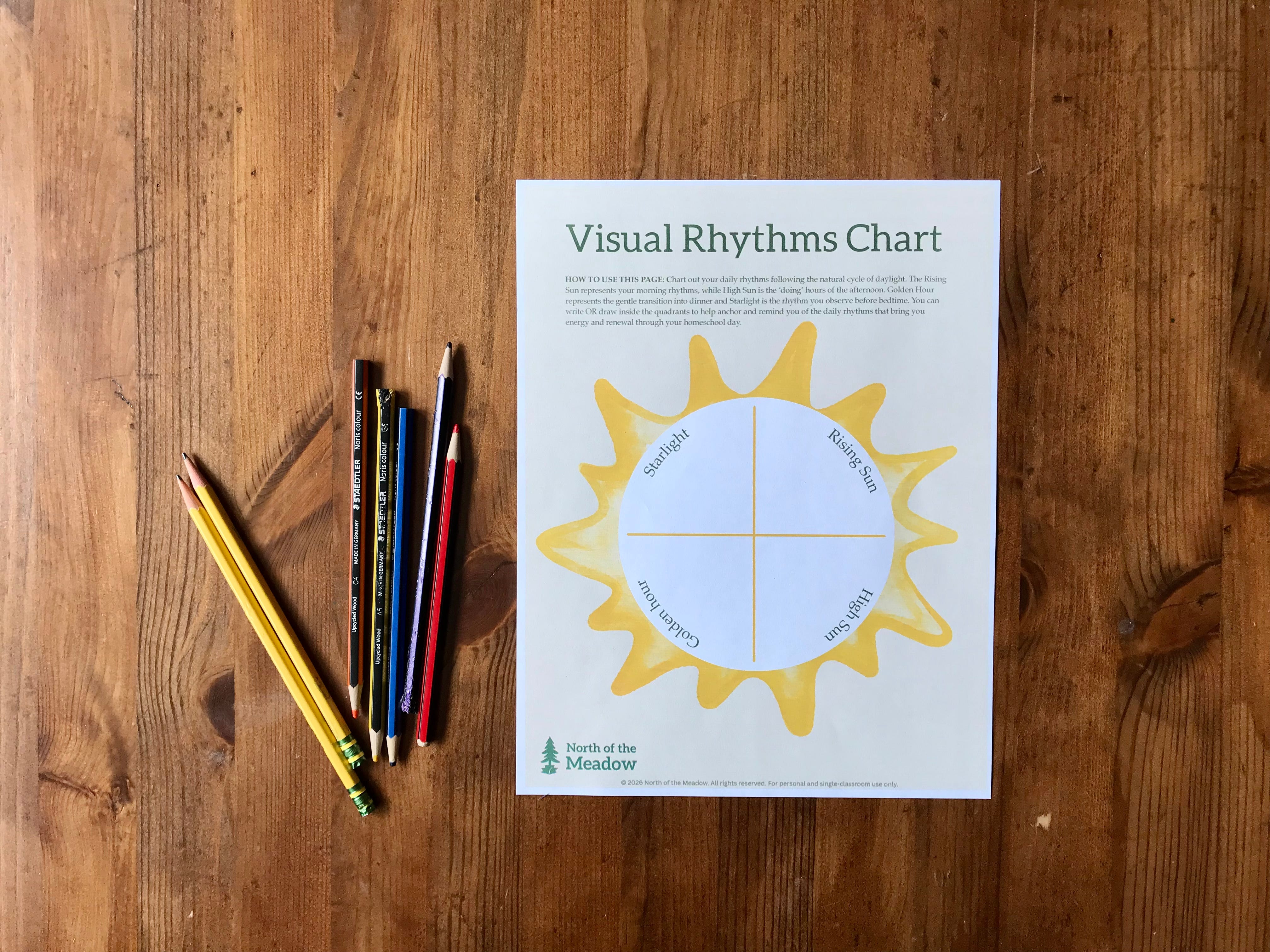
If you’d like a copy of this chart, be sure to Subscribe to the Sunday Notes Newsletter. You’ll receive the Chart as my FREE gift to you for joining us in addition to regular Notes of encouragement, prompts to help you simplify, and living book recommendations from me.
Three Ways to Start Your Sun Rhythm Today
Find Your Anchor Window: Choose one window in your home where the light is most beautiful. Make that the spot where you do your most important connection activity, like morning tea or reading aloud.
Match Chores to Light: Do active chores (vacuuming, laundry) when the sun is bright and high. Save quiet chores (folding, mending) for the fading afternoon light.
The Sunset Shutdown: When the sun goes down, turn off the big overhead lights. Use lamps, candles, or amber-toned bulbs to signal to everyone’s brain that it’s time to wind down.
“To everything there is a season, and a time to every purpose under heaven.” — Ecclesiastes 3:1
Living by the sun isn’t about being “primitive” or “anti-tech.” It’s about being human. It’s about honoring the biological reality of our bodies and the beautiful, rhythmic world we inhabit. Connecting with the mysteries of nature - that of the outside world as well as that of our internal world.
As the seasons shift, I invite you to put down the phone, look out the window, and let the light lead the way.